What you choose here is mainly the pan beneath the coating, as that determines what else you can cook with it. For each type, we mention pans from the overview, along with what their product page says. We share what we know about the coating as a store.
What is the difference between all those ceramic frying pans?
Beneath the ceramic layer, there are three types of pans here. The layer itself is not equally thick everywhere, and you can especially see that in how long you can cook on it.
Aluminium: the most choice, and the oven varies by line
Aluminium is underneath most of the pans here, and also under most entry-level models. Per line, it varies whether such a pan can go in the oven; that is stated in the specifications. The Beka Frying Pan Maestro Alu ø 28 cm can go in the oven according to its product page, up to about 200 °C.
The GreenPan Frying Pan Padova Reserve Pro Green ø 28 cm can also go in the oven up to 200 °C. Beneath its layer, which GreenPan calls Thermolon and is reinforced with diamond, is forged and hard-anodized aluminium. It weighs 1.32 kilos empty, and GreenPan advises against using a metal spatula in it. The same pan is also available in cream, and in ø 20 and 24 cm.
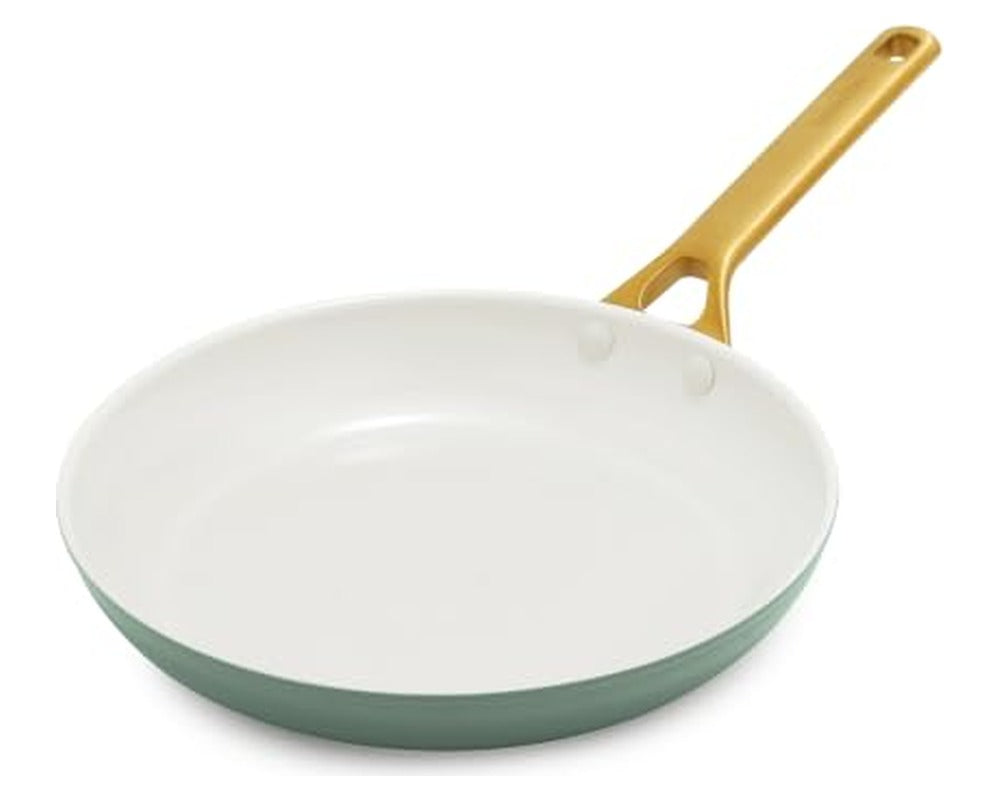
GreenPan Frying Pan Padova Reserve Pro Green ø 28 cm
Cast Iron: stays warm for a long time, but cannot go in the oven here
The Beka Frying Pan Mandala Cast Iron ø 28 cm has cast iron beneath the layer, and it stays warm for a long time after heating. It is not lead-heavy: in ø 28 it weighs 1.4 kilos, about the same as the heaviest aluminium pans here. According to its product page, it cannot go in the oven due to the acacia wood handle. If you want cast iron that can go in the oven, you can find that without a ceramic layer among the cast iron frying pans.
Stainless Steel with a honeycomb: for those who use a metal spatula
Stainless Steel is beneath the layer of the hybrid HexaCook pans, from our own brand. In a hexagonal pattern, that stainless steel comes just above the ceramic layer. That pattern catches a metal spatula, so you can use one here. These pans can also go in the oven, up to 200 °C.
How long does a ceramic layer last, and does a more expensive pan help?
You can cook on a ceramic layer for a few years, and how many years exactly depends partly on your purchase and partly on your kitchen. With a higher price, the layer is often thicker, and a thick layer has more to wear down than a thin one. Being careful with your pan extends its life, but does not prevent wear.
In your kitchen, these habits wear down a layer faster:
A metal spatula or knife in the pan: that damages the layer, so do not cut in it and use wood or plastic. The pans with a honeycomb are an exception, but only for the spatula.
Full power or an empty pan on the heat: that heat affects the layer, so lower the heat and add some fat first.
Cold water on a hot pan: let it cool down first, as according to several product pages here, such a temperature shock is bad for the layer.
Cast iron and stainless steel last a very long time without a layer, but with a ceramic layer, such a pan is also done once that layer gives out. You can recognize that moment by the bare metal becoming visible, or by a layer that peels off.
Can a ceramic pan go in the dishwasher?
According to the tick on their product page, most pans here can go in the dishwasher. That tick indicates that the pan can withstand the machine; for the layer, hand washing remains the better option, as dishwasher tablets wear it down faster. Also, on the product pages with that tick, there is almost always the advice to wash by hand.
The Mandala does not have a tick and should always be washed by hand. If something is stuck, you can find in our piece on how to clean your frying pan how to get it loose. Whether you use that tick is up to you. With the machine, you will be needing a new pan sooner, while by hand you can cook longer on the same layer.
Are you taking a single pan or a set?
In our shopping advice, a medium and a large frying pan are often preferred over one pan for everything. This is how the sets here are also composed: 24 and 28 cm, sometimes with a 20 cm one included. For size, you also look at how many people are eating with you; which size frying pan you need is listed per household.
Cooking and sauté pans are not included in any of those sets; you can find them with the same type of layer in the ceramic pan sets. Add up the prices of the individual pans in the overview before taking a set, as whether a set is cheaper varies by line.


