4.8 Trusted Shops 22.167 reviews
Free Shipping from 149,-
1,000,000+ satisfied customers preceded you
Celebrating our 10th anniversary this year
Free Shipping from 149,-
4.8 Trusted Shops 22.167 reviews
Free Shipping from 149,-

Pans from gas to induction

Can your pans go from gas to induction?

Yes, if their base is magnetic and after all those years on gas it is still flat. You don't need special induction pans. A percolator or an earthenware cooking pot usually stays cold on induction, but you can still use them with an adapter, if you're patient. More changes at the stove than in your cupboard: on induction you cook at a lower setting than you're used to with gas.

Can your pans go from gas to induction?

What from your kitchen cupboard can go to induction?

What will work on the hob can already be indicated by a fridge magnet: anything the magnet sticks to under the base. The magnet only tells you that a pan will work, not how well it will cook; for that the base also needs to be flat. If there's a symbol or size on the bottom of the pan, it's useful to know what the bottom of a pan tells you.

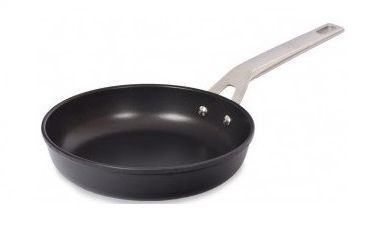
A frying pan or sauté pan with a non-stick coating can work if there's magnetic metal in the base. Test it on the hob, because after years on gas the base can be warped. Don't keep a pan with a damaged coating.

Saucepans and saucepan-pans (with long handles) will often work on induction. Test them to be sure, just like your roasting pans.

Cast-iron roasting pans and skillets work on induction, bare or enameled. A rough bottom can scratch the glass. A carbon-steel pan or steel wok also works. If it still needs seasoning or needs to be reseasoned, plan the seasoning step by step before you remove the gas stove.

A wok with a round bottom will wobble on the flat glass. If you choose the woks that work on induction and pick a wok with a flat base, it will sit still. Expect to stir-fry more than traditional wok-tossing on the hob.

Whether a pressure cooker works depends on its base, so test it like your other pans. If it stays cold, then the WMF Snelkookpan Perfect Plus ø 22 cm does work on induction.

For a kettle it also depends on the base, even if it's stainless steel. So test it. On our induction hobs the Alessi Fluitketel Tea Rex 2 liter and the Alessi Fluitketel Bulbul 2.5 liter, both from the more expensive range, work on induction.

A classic aluminum percolator won't work on induction, but you can keep it with an adapter. We don't currently offer a percolator that works on induction. An earthenware tajine or cooking pot usually won't work, but you can keep those with an adapter as well. A cast-iron tajine does work; see whether your tajine can be used on induction.

Cookware without a magnetic base is not worn out, and a new piece made from the same material won't work either. You'll understand that as soon as you see why some materials stay cold on induction.

What from your kitchen cupboard can go to induction?

When is an induction adapter a solution?

An induction adapter is a metal intermediary plate for the cooking zone: your hob heats the adapter, and the adapter transfers the heat to whatever is on it. That way you can keep cookware that stays cold on induction, like a percolator or an earthenware pot. Also a favorite pan that you mainly use for slow-cooking can come along this way.

On an adapter it can take a bit longer for the pan to get hot, and your hob will run less efficiently. For something you use occasionally that matters less than for the pan you use every day. For a good sear on meat you’re better off with a pan that itself works on induction.

When using an adapter, stick to these rules from our usage tips for an induction adapter:

  • Only put cookware on it that has a completely flat bottom and that doesn't overhang the adapter by more than 2 cm on any side.
  • Start on a low setting and increase the power slowly; never use the highest setting or the boost mode: this prevents overheating.
  • Never leave the adapter on a zone that is switched on and empty.
  • Remove the pan with oven mitts from the hob, because the adapter itself also gets hot.
  • Don't use the adapter as a griddle: do not place food directly on it.
When is an induction adapter a solution?

How do you cook on induction if you come from gas?

On induction a pan can scorch that never gave problems on gas, even though the hob might not feel very high. A gas flame builds heat gradually; an induction hob transfers it to the pan immediately.

Our pan expert translates what you're used to on gas into induction like this:

  • To heat up the pan on gas you turn the flame high until the pan is hot. On induction choose around 60 percent of the power; leave the highest setting and the boost alone.
  • To fry on gas you adjust by eye to the visible flame. On induction pick around 40 percent, and set that level before you put the food in.
  • To lower the heat on gas you turn the burner down and the flame gets smaller immediately. On induction you first select the zone with the touch controls and then turn it down; start a moment earlier.
  • To warm cast iron on gas you let the flame do the work and it comes up to temperature on its own. On induction increase the setting in a few steps, not all at once.

If your food still burns at these settings, then it's time to examine the pan itself.

How do you cook on induction if you come from gas?

How do you test an old pan on your new hob?

Test an old pan on the countertop and then on the hob itself:

  1. Run your fingers over the bottom, because sharp edges or rough spots, for example from sliding over the pan supports, can scratch the glass. Then slide the pan over a newspaper: a pan that tears the paper should be kept away from the glass.
  2. Lay a ruler over the inverted pan: if the ruler tilts at the middle, the base is convex and the pan won't work well on induction. A slight inward concavity can be okay, since such a base sometimes flattens when it gets hot.
  3. Find a zone about the size of the pan’s bottom, even if on gas you always used the large burner. That zone should activate immediately, without the pan symbol starting to blink.
  4. Melt a knob of butter on a low setting: the butter should foam across the whole base at the same time.
  5. Cook with it a few times at the settings above: if your food still burns or only the middle gets hot, this is the first pan you should replace.

After years above a gas flame a base can lose its shape. Then the zone sometimes stays off, even with a pan the magnet sticks to, or the pan may cook harder in one spot than another.

How do you test an old pan on your new hob?

What do you replace first after the switch?

The first new pan is the one you use every day and the one that failed the test. Often it's a frying pan, such as a skillet. For that first replacement compare the frying pans we recommend for induction, even if you want to cook without a coating.

Saucepans and saucepan-pans can usually wait; keep them as long as they pass the tests above. This spreads the expense, besides the cost of the hob and sometimes work in the fuse box. If most of your cupboard fails the test, then start fresh with a set that works on induction.

Can pans made for induction also be used on gas?

Every pan will get hot over a gas flame, including one with a base made for induction. What you buy now for your future induction hob can therefore be used on your gas stove immediately. Be careful with a light pan with a heavy handle on the pan supports, because such a pan can tip.

After the frying pan you usually replace the wok and the sauté pan, and for both you can follow what we recommend per pan type for induction.

What do you replace first after the switch?

Related howto's