4.8 Trusted Shops 22.167 reviews
Free Shipping from 149,-
1,000,000+ satisfied customers preceded you
Celebrating our 10th anniversary this year
Free Shipping from 149,-
4.8 Trusted Shops 22.167 reviews
Free Shipping from 149,-

Best frying pan for induction

When is a frying pan the wrong choice for induction, even if it’s expensive or tested?

On induction, the wrong frying pan is usually one that only partially works: it functions, but doesn’t brown evenly or hold up for long. You can spot this by one of these three signs:

  • Only the center browns, or the cooktop doesn’t recognize the pan: usually the pan’s base is smaller than the cooking zone.
  • It browns on the bottom but hardly on the sides: often the magnetic metal is only in a disc on the base. That disc transmits heat poorly to the sidewalls.
  • The pan doesn’t sit flat on the glass: usually the base has warped into a dome, reducing contact with the hob. Such a pan browns worse and isn’t energy-efficient.

In the Consumers' Association test of 13 PFAS-free 28 cm frying pans, every base permanently warped at high temperatures, even a thick one. A good test result therefore tells you little about what prolonged use at high settings will do to a pan’s base, and a high price says little as well.

In our years in the shop we often saw two things together when results on induction were disappointing: a high setting and a pan that wasn’t ideal. A domed base is therefore not proof you did something wrong. The pans at the top of our list also require two settings: about 60 percent to heat up and about 40 percent for frying. A thick multi-layer base will dome later than a thin one, but even the thickest won’t hold up indefinitely at the highest setting.

When is a frying pan the wrong choice for induction, even if it’s expensive or tested?

In what order do we recommend frying pans for induction?

The higher a frying pan ranks in our order, the better its construction distributes the cooktop’s heat and the less it depends on your power setting or prep. The construction of the base and whether a pan needs to be seasoned first are stated on the product page, so you can check each position yourself. How much construction and prep weigh in our advice comes from our years in the shop. There we learned what each material demands on a hob that heats up quickly.

Whether your pan should have a non-stick coating depends, as with gas, on what you cook and how much effort you want to put in. If you’re undecided, or want to know what chefs use, read which frying pan we recommend independent of your cooktop. We list each pan in a single size; to pick the size that fits your hob, look at how large the base of a pan is compared to your cooking zone. The current price is shown on each product page.

With a non-stick coating

With a coating, this is our ranking on induction:

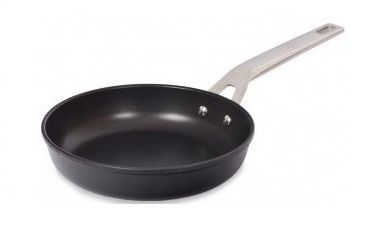
  1. SCANPAN Koekenpan HaptIQ ø 28 cm tops the list: according to the product page, the aluminum core in its five layers spreads heat across the whole base and up the sides. It’s for anyone who has already seen a pan warp and doesn’t want to skimp on construction even with a coating; it’s one of our most expensive coated frying pans.
  2. Cookinglife Koekenpan HexaCook ø 28 cm is our own brand and has three metal layers: stainless steel around an aluminum core, with a ceramic coating on top. It ranks lower because it has three layers instead of five; the product page doesn’t say whether those layers run into the sidewalls.
  3. Beka Koekenpan Mandala Gietijzer ø 28 cm has a ceramic coating and is made entirely of cast iron, so it doesn’t need a separate magnetic disc on the bottom. It ranks lower because you should warm cast iron slowly on induction; choose it if you want PFAS-free cooking and have the time for it.
  4. Sola Koekenpan Ceramic Deluxe ø 28 cm is placed at the bottom because the product page doesn’t say how the induction base of this aluminum pan with a ceramic coating is constructed. For anyone who wants a light pan that’s dishwasher-safe, it’s an easy choice.

If you want to avoid PFAS, number 1 is out: the SCANPAN has a standard non-stick coating, the other three have ceramic coatings, and the pans after these have no coating at all. If PFAS avoidance is your top priority, read which PFAS-free frying pan we recommend.

Without a non-stick coating, even if you don’t have a gas burner

Without a coating, this is our ranking, even if you only cook on induction:

  1. Beka Koekenpan Maestro 5-Ply ø 28 cm tops the list: it has five layers with an aluminum core, and according to the product page those layers also run up the sidewalls, and it doesn’t need seasoning. Choose it if you want a crust without a wearing coating; it’s one of the pricier uncoated pans.
  2. Beka Koekenpan Stark ø 24 cm is made of cast iron and comes pre-seasoned from the factory, so you can cook in it immediately, without a gas burner. It ranks lower because, like the Mandala, you warm it up slowly; aside from that it’s quite heavy at 1.67 kilos.
  3. De Buyer Koekenpan Mineral B Pro ø 24 cm is last: this 3 mm steel plate needs to be seasoned, and that can be done on a gas burner, not on your induction cooktop. It suits those who can use a gas burner and want to sear meat hard, because steel plates get very hot; read first what seasoning a steel pan involves.

Between number 1 and 2 you choose based on how you cook and how you wash up. The Maestro 5-Ply is dishwasher-safe, and the Stark releases its heat slowly to meat that needs to rest after searing.

In what order do we recommend frying pans for induction?

What you don’t need to spend money on for induction

You can skip these four things for induction:

  • A new frying pan, as long as your current pan doesn’t show any of the three signals above: you can keep using it on induction.
  • A pan just because it’s labeled “especially for induction”: how it performs on the hob mainly depends on the construction we used to order the lists above.
  • The top coated pans, if you rarely use high power on the hob: then a pan further down the list, like the Sola Ceramic Deluxe, is fine.
  • A disc under a pan that doesn’t work on induction: on forums such a disc is often called a “simmer plate,” and simmering is not what you buy a frying pan for. For the rest of your cookware, read what to do with your pans when switching from gas to induction.

Saving money backfires on induction if you often sear at high heat: then the base takes a lot of strain, and our ranking rests on the construction of that base.

What you don’t need to spend money on for induction

What happens if you put a regular pan on an induction hob?

A regular pan that isn’t suitable for induction will remain cold on the hob, because the cooking zone won’t switch on. Your cooktop won’t be damaged by that. You don’t need to throw the pan away: you can continue to use it on gas or a conventional electric cooktop.

Unsuitable pans are those without magnetic metal, such as pure aluminum pans and most copper pans. A frying pan with a ceramic non-stick coating is not a pan made of ceramic. That coating is usually on aluminum, and with magnetic metal in or under the base such a pan will work on induction.

Before you buy something new, for a pan you already have you can do the magnet test and the induction symbol check.

If you’re also looking for the other pans for your hob after the frying pan, read about the best pans for induction, from saucepans to sauté pans.

What happens if you put a regular pan on an induction hob?

Related products

Related howto's