4.8 Trusted Shops 22.167 reviews
Free Shipping from 149,-
1,000,000+ satisfied customers preceded you
Celebrating our 10th anniversary this year
Free Shipping from 149,-
4.8 Trusted Shops 22.167 reviews
Free Shipping from 149,-

Is Teflon dangerous or not? What are the alternatives?

Is Teflon dangerous or not? What are the alternatives?
But what alternatives are out there? Find out in this blog!
Carbon steel pans

Carbon steel pans

A carbon steel pan is made from 99% iron, making it a completely natural product. Before first use, these pans need to be seasoned. It's not difficult, but it does take a bit of time. The seasoning process creates a dark layer that acts as a natural non-stick coating.

If something goes wrong in the kitchen, the pan isn't ruined. At worst, you scrub it clean and re-season it. With a Teflon pan, a cooking disaster means straight in the bin! Keep your pan well oiled, as carbon steel can rust easily if neglected. Carbon steel is a strong and durable material, meaning these pans can last a lifetime.

Advantages

  • Handles high temperatures well.
  • You can use metal utensils.
  • Affordable.

Care & Maintenance

  • Pan must be seasoned before use.
  • Clean with water only — no dish soap!
  • After use, dry immediately and lightly oil if needed (carbon steel can rust otherwise).
Cast iron pans

Cast iron pans

Cast iron pans are made to last a lifetime — unless you drop them.

Advantages

  • Slow to heat up, but retains heat for a long time.
  • Heat distribution is excellent.
  • Handles high temperatures well.
  • Perfect for searing meat or caramelising.
  • Cooks best when the pan is kept well oiled.

Care & Maintenance

  • Treat a cast iron pan with care.
  • Cast iron pans need to be seasoned.
  • Clean with water only.
  • Let the pan cool completely before cleaning.
  • After washing, apply a thin layer of oil.

Want the benefits of cast iron without the maintenance? Then enamelled cast iron pans are the way to go! As the name suggests, they're finished with enamel — an ultra-thin layer of glass that works much like a Teflon non-stick coating, but without the toxic substances. These pans are easy to clean.

Copper pans

Copper pans

Copper pans are especially popular among professional chefs, who often use them for making sauces.

Advantages

  • Stylish appearance.
  • One of the best heat conductors available.
  • The interior is (usually) lined with stainless steel, making the pan less susceptible to both mechanical damage and chemical reactions between copper and food.
  • Copper pans are relatively expensive, so we advise against using metal utensils in them.
  • Clean with warm water and dish soap. The exterior can be kept looking brand new with copper polish.
Stainless steel pans

Stainless steel pans

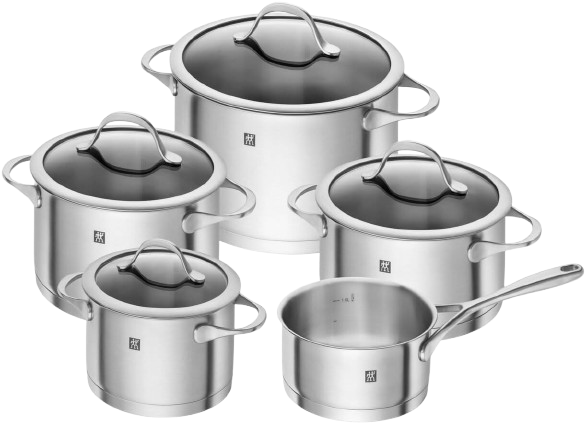
Stainless steel pans are excellent for high-temperature cooking. Food cooked in a stainless steel pan tends to stick to the base for the first few minutes — don't worry, that's perfectly normal! Once the proteins set and the food caramelises, it will release on its own. Be patient and only move your dish once it comes loose. Stainless steel pans are often built with a sandwich or multi-ply base incorporating aluminium or copper, making them excellent heat conductors that keep food warm for longer. The pans are dishwasher safe, but will stay looking better for longer if hand-washed.