At Blackwell, almost every steel frying pan is 2 mm thick; at De Buyer and Forged, the steel is 3 mm. For you, this mainly means a difference in weight, and the handle also varies per line. The choice comes after the work that belongs to every steel pan; our pan expert also indicates who should choose something else.
Is it really that important with a steel frying pan?
In five points, yes:
Season the pan once before using it for the first time. The seasoned oil seals the steel, so food sticks less and the steel rusts less quickly.
Always heat the pan with enough fat before cooking. In a pan that is not warm or has too little fat, food will stick.
Wash the pan by hand after each use, with little dish soap and without abrasive cleaners, so not in the dishwasher. Dishwasher tablets, too much dish soap, and abrasive cleaners will remove the seasoned layer.
Dry the pan over the heat after each wash, until the last moisture is gone. Steel that remains wet will rust within a day.
Make acidic dishes, such as tomato sauce, in a different pan each time. Acid removes the seasoned layer.
For seasoning a steel frying pan, we have a step-by-step plan. If something goes wrong, you can scrub the pan clean and season it again. This applies to rust and to a layer that has disappeared due to acid or the dishwasher. According to our pan expert, there is nothing wrong with the pan, although it is quite a job.
In a steel pan, you can cook a steak with a brown crust, and with proper maintenance, the pan will last for years.
When do we not recommend steel, or suggest a second pan?
In these cases, our pan expert recommends a different pan or a second pan alongside your steel pan:
Choose a non-stick pan from all frying pans if you are just starting to cook, or if you already know that drying on the heat will be neglected.
Choose stainless steel if everything goes in your dishwasher: most stainless steel pans can withstand that, and steel loses its seasoned layer.
Keep a non-stick pan for eggs and fish; in steel, you can also release an egg, but it slides less easily from the bottom.
Make tomato sauce and other acidic dishes in a stainless steel or non-stick pan, and save your steel pan for what you want to sear.
Arrange a gas burner for seasoning if you only cook on induction, or take a pan that does not need seasoning. According to our pan expert, steel does not reach the temperature required for seasoning on an induction plate.
Steel is a good choice if you no longer want to replace a non-stick pan, or if a nice steak is worth the effort for you. For those who have not yet chosen the material, steel, stainless steel, and cast iron are grouped together in the frying pans without a non-stick coating.
What is the difference between thin and thick steel in weight and cooking space?
What is the difference between thin and thick steel in weight and cooking space?
A steel pan feels heavy as soon as you flip a pancake with a flick of your wrist or lift a full pan off the heat. Empty weight and bottom width for thin steel (2 mm) and thick steel (3 mm), in several sizes that you find in both thicknesses:
In ø 20 cm, thin steel weighs 0.77 kg with a bottom of 15.6 cm, and thick steel weighs 1.03 to 1.1 kg with a bottom of 13.5 cm.
In ø 24 cm, thin steel weighs 1.05 kg with a bottom of 18.6 cm, and thick steel weighs 1.41 to 1.49 kg with a bottom of 17.0 to 17.5 cm.
In ø 28 cm, thin steel weighs 1.32 kg with a bottom of 23.0 cm. Thick steel weighs 2.18 to 2.35 kg, with a bottom of 20.0 to 21.0 cm.
In ø 32 cm, thin steel weighs 1.82 kg with a bottom of 25.4 cm, and thick steel weighs 2.62 to 2.98 kg with a bottom of 22.5 to 26.0 cm.
Not every pan lists weight and bottom size; this list only includes what has been specified. In 28 cm, a thin pan is about a kilo lighter than a thick one. In 20 and 24 cm, the thin pan also has the wider bottom, providing more cooking space.
Pans of 18 and 22 cm are only available in thick steel, and the same applies to the wooden handle.
If you often flip something or lift the pan a lot, the Blackwell Frying Pan Carbon Steel ø 24 cm is suitable. With 2 mm steel, it weighs about 0.4 kg less than a De Buyer pan in that size.
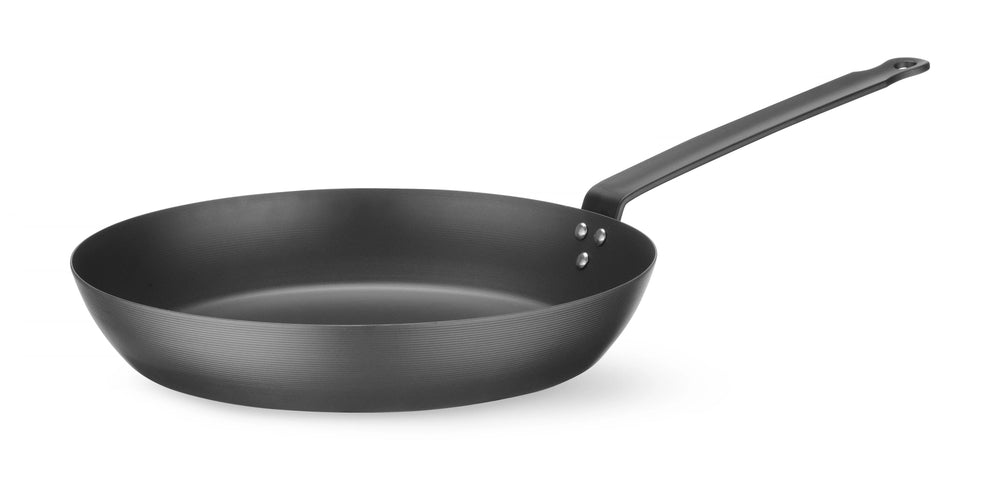
Blackwell Frying Pan Carbon Steel ø 24 cm
In the Blackwell Frying Pan Set Carbon Steel 2-Piece, this pan and the 28 cm one are included. If you replace a medium and a large non-stick pan at the same time, you can get them in one order.
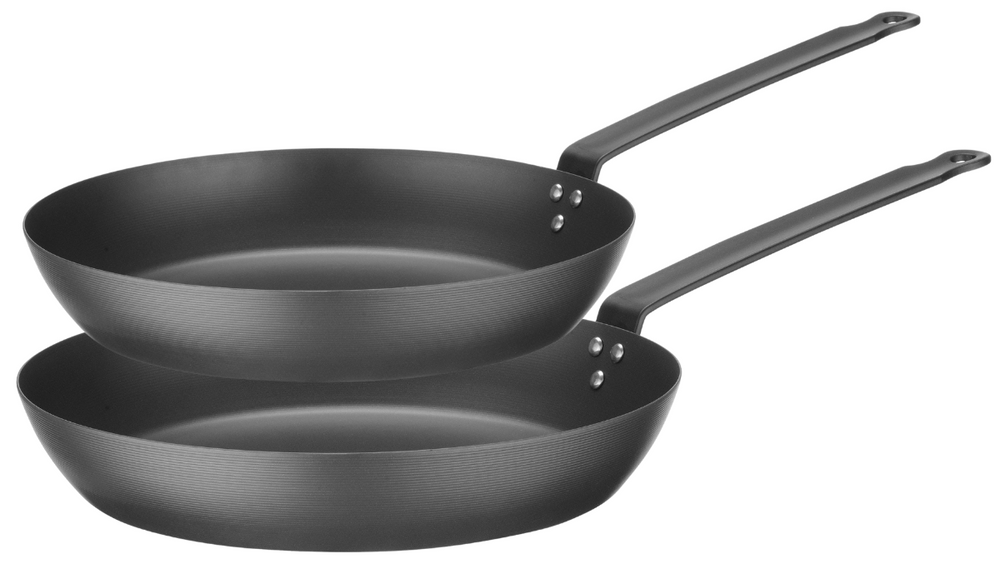
Blackwell Frying Pan Set Carbon Steel 2-Piece
Where do you hold a hot or full steel frying pan?
You only notice the difference at the handle when the pan is hot or full:
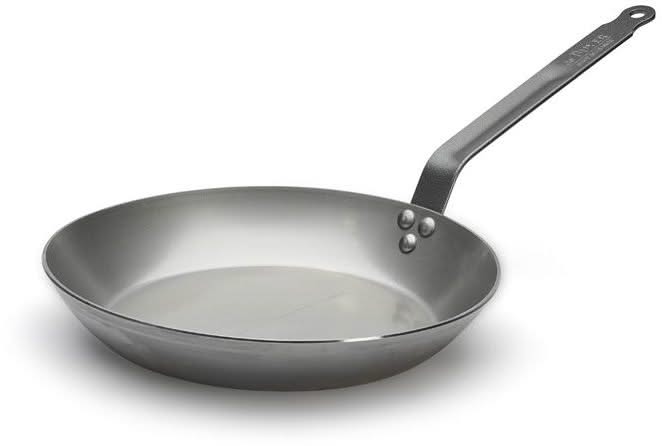
De Buyer Frying Pan Lyonnaise Carbone Plus ø 24 cm
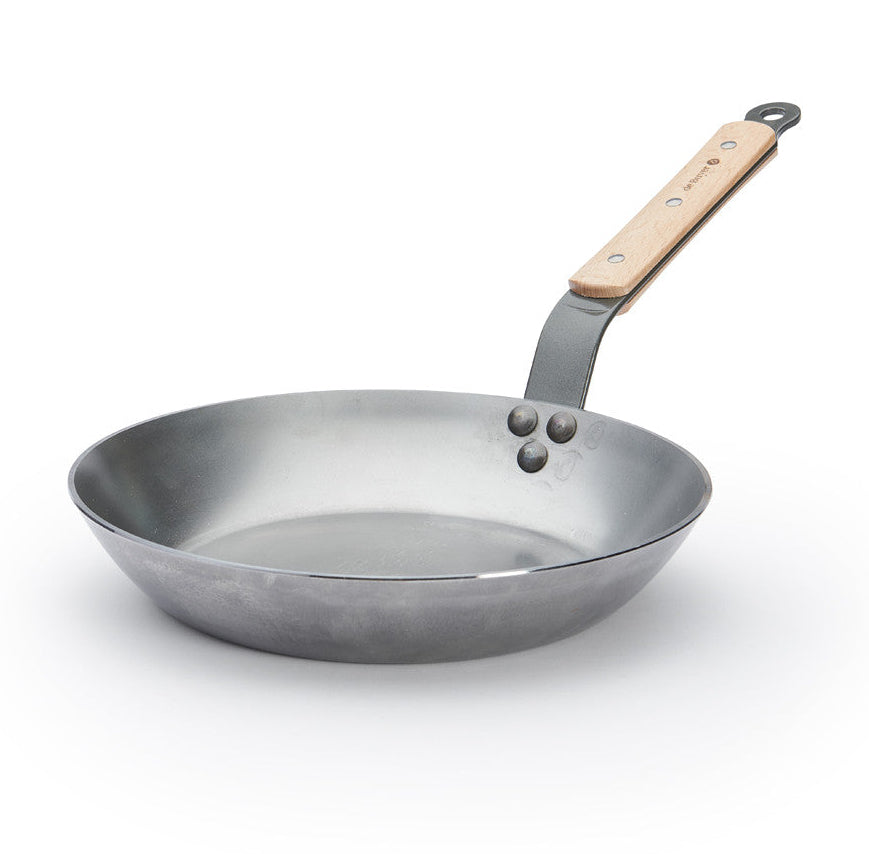
De Buyer Frying Pan Mineral B Wood ø 26 cm
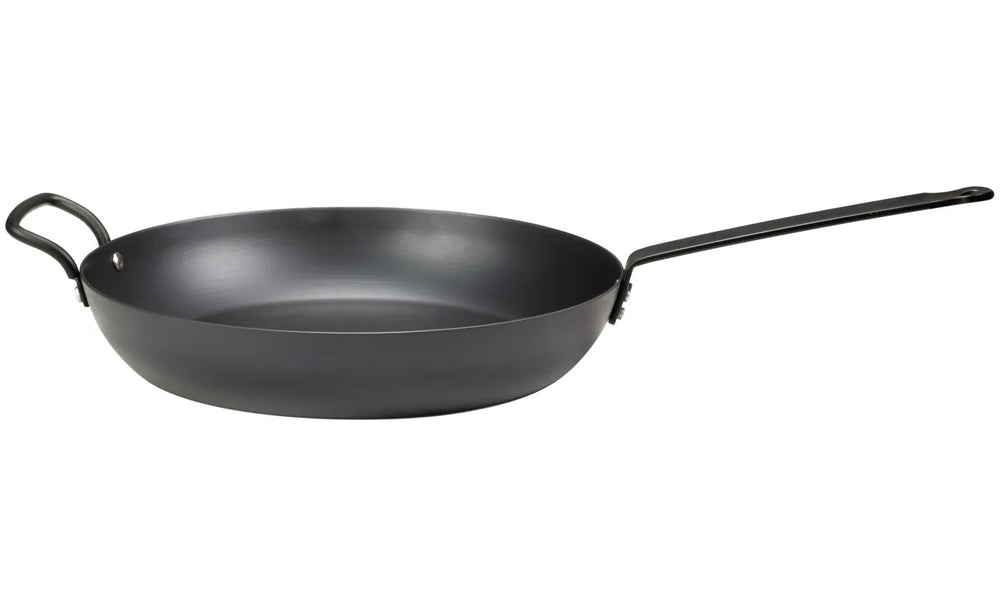
Blackwell Frying Pan with Handle Carbon Steel ø 32 cm


 -20%
-20%


